Finger Positions
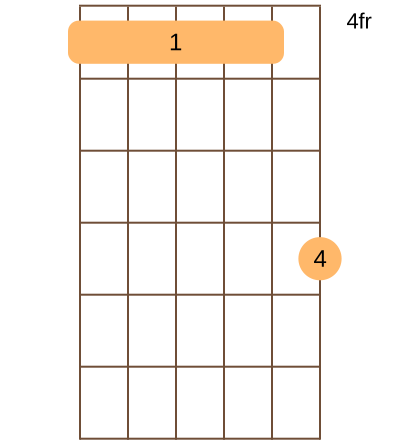
How to play the D#m7#5/G# Chord
The D#m7#5/G# is a fundamental dominant chord in guitar music. To play this chord correctly, ensure your fingers are placed precisely on the frets indicated in the diagram above.
Music Theory Analysis
From a theoretical perspective, the D# over G# is built using the 1P, 3m, 6m, 7m intervals. In the key of D# Major, this chord functions as the I chord.
Common Progressions
In music composition, the D#m7#5/G# chord is often used to create tension or resolution.
The Diatonic Family
Understanding the "family" of chords that belong to D# helps with transposition and ear training.
Scale Compatibility
View All Scales* 11 scales found containing the notes G#, D#, F#, B, C#.
Acoustic & Digital Analysis
Digital footprint of the D#m7#5/G# chord for MIDI programming and synthesizer sound design.
68, 63, 66, 71, 61
415.3046975799451, 311.1269837220809, 369.9944227116344, 493.8833012561241, 277.1826309768721